Something about happiness

This morning I woke up thinking that, in fact, there is no truth in the already well-known idea that every human being is beautiful in its own way. The truth is, I think, that every human being is beautiful in all the possible ways because each of them bears the potentiality of doing something beautiful (let’s face it, we are capable of great things when we’re passionate about something, Lincoln for instance). Anyways, some of us sing (badly, while under the shower), some of us paint, some of us write, and some of us are just beautiful. We manifest beauty. And well, here’s to beauty…and happiness.

P.S. I wrote this while in Reggio Emilia. If you were there, this is about you (yes, you).

The beast in the tall grass

Born in that summer morning, we both stood outside in the tall grass without the fear of snakes. And the apples grew yellow and red, and the sky was of a constant blue, cloudless. I could see the sweat running down your forehead and I wanted to wipe it off, but the world wouldn’t let me do it. At night, I would cry because I knew that later on, even yawning will have a dark significance. The body will grow big, and the mind will have to develop techniques to understand it. I wish I could say I love you. Because I do. But this word, love, comes from a place of confusion. And if I tell the truth that truth will consume me, and it will take you away from me. And I don’t want that. Let us remain and forget about the inevitable storm. Let us touch, but only in our minds, let us make love without the truth being present. You’ll lie down, and I’ll be right beside you and the sky will have a whole new meaning. Smile. The sun is just right. What shall we do, you ask, when grandfather or even father, shall find us sleeping in the tall grass, attached to each other in the fury of the evening? We’ll hear only the sound of the steps cutting through the yellowish grass and the sun and the sky. We’ll do nothing, I say. We’ll wait in silence, so as to hear the wrath of those steps as they walk away, shoes filled with knowledge. We’ll have, by then, nothing else but our love and our bodies attached to each other. By the time the steps have vanished our gods would have disappeared too. Father, how could it be? How come from a body like yours a beast like me could have risen? How could that architecture go wrong? By means of a thought? As I go home, taking after father’s steps I watch you sleeping covered in light. I know at home I’ll find this silence multiplied by ten and sprinkled with anger. Why did you keep this away from us? I was afraid, father, I’m afraid of what might come, of what will come. I’m afraid it’s nothing, and how could you live on nothing, how could you? Of all the people in this world, how could you, father?

The empire no-more

You need a certain tone to talk about this. Sit on a desk if you have to, in front of an imaginary sea of students, your feet swinging like those of a child licking a lollipop. You are the professor, that means you know things, you’ve spent more than fifteen hours a day reading stuff and trying to write about them, make them understandable for the unripe minds of future generations. Emphatically, you’ll raise your voice and say that empires do fall, oh, they do, oh, a most unfortunate condition for any type of societal construct, actually, a most unfortunate condition for any type of pride there is. At this point, please notice that your students stand frozen looking at you, wondering whether you’ve gone mad or it is only a transitory moment of rebellion against everything, the state especially, politics and morality, and all those boring things that make a life complicated. Some of them will rejoice because, at last, they found a leader for their youthful hipsterism. Why do they fall, professor, why do empires fall? Because some of us get creative, you’ll say after a dramatic pause, and while waiting for your students to write down this immense idea. There are norms, you’ll say, norms to which some of us won’t comply, or can’t comply. Roles that some of us shall refuse to perform. Oh, how grand you’ll sound, but only in your mind. Your students will laugh, though not in your presence, only then, when they’ll see your humble figure haunting the dark corners of an obscure public library. Later, they’ll say it was an attack against same-sex marriages that lead the world to infertility and empty wombs. Oh, look how the empire is crumbling! You’ll die in the meantime, professor, and your students will never know what you meant. What a pity, and a most unfortunate condition that is…

To a dear friend at home

I didn’t get your last letter. You probably wrote a lot of interesting things in it, old things turned into new ones, marriages, deaths, lost friendships and found ones. All those things which make up a life. So, thank you, I needed all that. But, now, how could I tell you that I met nobody on the way, since our lives revolve around meeting people? And that I have no friends here, that I know nobody, and that I stay silent my entire life here. A sort of crust covers my lips in the morning, and sometimes my eyes. So this letter must sound joyful, it must have great things in it, discoveries, culture shocks, culinary adventures, and smiles, and sex with unknown boys in public bathrooms. So that life would sound grand over here, yes, you might think. It is, life is grand on the other side of the line ’cause it takes a lot of courage to cross the line and call things by their own name. Well, frankly, I can’t call things by their own names because I need to hide in order to be happy. So, yes, I do tell you I am happy, as much as a human being can be, and have lots of friends, and good-night-kisses, and a cute dog. That I have coffee at the coffee-shop in the singles’ area, and that I have a personal hairdresser who thinks I’m some sort of rock star. And that I go to read books in fancy, bohemian coffee shops with fake artists and poets, and walk the streets at night and go to obscure clubs with alternative guys who look good only when they are naked. So that you may feel jealous. That there are people who love me and because of that I feel secure. But, the truth is, I don’t. There are no such people. But you need to know that I am happy ’cause when I’m happy you’ll think that you can be happy too. That happiness is made for humans, and that it is not impossible to reach, that you can touch it. A possibility is better than nothing, don’t you think?

So I tell you that my life is great…

…except that from time to time I see saints and angels in other people, and in every smile the mysteriousness and beauty of nights spent together with love, and sweat.

The Merry Christmas

I haven’t thought a lot about this though I must admit that there have been a few days since I said to myself that I should write at least something for the coming holidays. Christmas has never been magical for me although when I was little I dreamed of great things happening on Christmas. I believe Christmas is all about family and nostalgia. I know, this might sound pathetic, but Christmas is a holiday of change which produces great doses of longing for something which has already passed, be it childhood, a dead dog, or a dead cat, an absent family member etc. It is the day when all these things come back despite the fact that you have to live the rest of your life with those things, Christmas is when they are most painful. It is no wonder that suicide rates go up on this time of the year. The economic crisis is another thing that comes back on this time of the year. But what else is Christmas beside politics and consumerism, and uneven development?

Yes, right, hope. The pagans used to bring fir trees into their houses because they thought that this is the way to keep life from being killed by the coldness of snow. Always green, fir trees became to symbolize life itself. The custom was later appropriated by the Christians, and thus the fir-tree became the Christmas tree. Take that, you pagan pagans!

So, during this time of the year, the hope rates also go up. Can you feel the joy?! I don’t, but anyways, I’ll have to live with that.

And another thing. Do you remember those things that you promised yourself you would do at the end of 2009? I said I was going to lose weight, get some abs, be happy etc. Well, take a look back and think of the things that you have fulfilled during 2010. Personally, I did absolutely nothing, and here I am at the end of 2010.

The solution?! Yes, stop making plans, see how it goes. I’ll meet you at the end of 2011.

Happy Holidays!

The Baptiser

His left shoe got stuck. The humid leather refused to let go. So he sat on the rocky shore of the river and pulled the shoe with both hands until it gave in. He placed the shoe symmetrically next to the other one and looked at them with a boyish pride. Then watched as the river went like a snake between the sharp corners of a bare mountain. It was a sunless day. Still, it was a promising day, he had thought. Let yesterday die with its shameful face, he said to himself. That morning had to be a blessing. On his way to the waiting spot he met a very young fellow with a handsome face and such apparitions were rare except those people who stopped their cars and took pictures of him. This young fellow did not have a camera and was wearing a rather fancy suit. The only strange thing was that he had a little notebook and took notes. So he must have been one of those sent to test his faith or to see if he was still doing his job. He works in mysterious ways. The people with the cameras were also testing his faith. Each time they came he could barely stop himself from swearing and doing obscene gestures with his hands. But good-looking fellows were a good sign.

The greenish water shyly caressed his toes. It was cold as ice. And smelly too. But suffering is a virtue of the flesh, just like pleasure. Still, pleasure has nothing to do with it, at least not here, not now. A few meters away the mouths of three sewers opened hungrily. A guardian at the gates of an unknown hell tied together with an endless highway. People in cars coming and going.

Today is the day. The water is so cold.

He forgot his stick on the shore. He went back to get it. Then resumed his position, ankles completely submerged in the slimy water. He could see his toes from time to time. And feel the numbing sensation of cold. So he waited for somebody to come and ask for his services.

And then the day drew to an end. The next morning the young fellow came again and took notes in his little notebook. He wore a different shirt but the same fancy suit. Then another day ended and the next morning the same fancy suit took notes. And every morning the same thing. He must have been a customer.

Then he asked the fancy suit what his name was and his name was Ycnaf Tius. And what kind of name is that. It was his father’s name and the name of his son and the name of his future grandchildren. And the name of his wife was also Ycnaf Tius. And how do you call your city? Horse, Ycnaf Tius replied. And every object bears this name, horse. And how do you say ‘I go to sleep every night’? And Ycnaf Tius said ‘I go to horse every horse’. Linguists were working day and night to simplify the vocabulary and the syntax so lately everything was horse, horse, horse. ‘I go to sleep every night’ becomes ‘horse horse horse horse horse horse’. And so horse (on) and so horse (forth). Et horse (etcetera).

Would you like to be baptised? He asked Ycnaf Tius.

Horse horse horse horse horse horse. Ycnaf Tius replied.

I said would you like to be baptised into the true faith? He asked Ycnaf Tius again.

Horse horse horse! Ycnaf Tius replied and left. He never came back. Other people came instead of him and they all spoke the same language. Kids laughed at him, pointing and saying ‘horse horse horse horse horse!’ He took every horse in silence pretending not to hear. By night groups of horses attacked him, by day his vision was flooded with white doves.

People came and questioned him but he refused to answer. He kept repeating the word ‘dove’.

Dove dove dove, dove dove dove dove dove dove dove dove dove dove!

The Forbidden Sip

I share my bed with visions of white nights and an illusory craving for sleep. During the night the mirror is like an open hand. In the dark the mirror resembles a sweaty palm. When I look into the sweaty palm I see you and your eyes are like pores. I turn the mirror over the sheets and I can see your elbows. I see everybody’s elbows. All the people in this world have elbows and every cup of tea would be incomplete without an elbow. I could put my finger under your elbow and pull you out of the sweaty palm. I take the cup to my lips and feel the odour of boiled leaves of tea and lemon. Each time I pull you to my lips I hold you by your elbows. That is why in the morning your elbows look like the smooth white ceramic of a teacup. You smell like lavender. I’m thirsty but the cup is empty and you say I shall never have this drink because it is forbidden. By the use of malevolent hands this drink is cautiously hidden under many layers of elaborate movements and mind traps. And thoughts and islands that swim in never-ending oceans. I’m thirsty and I want to have a sip. So I go back to the mirror in my room and have a sip from it. The mirror that once reflected you. And say get off me. Nobody’s going to take care of your flowers while you are gone. This sip is forbidden. People shall look at you with a wicked eye. I cannot deny the sculpted look of this cup resembling your parted lips. I cannot say that here. The mirror has eyes and might talk. I plant olive trees every time I want to have that forbidden sip. Have a mouthful of it. I still have enough space for olive trees. So I play, play, play with this shirt of yours. I can’t find my words between its folds. You haven’t used too many words here. Just the usual stuff I guess, nice weather, really hot outside today, it is the time of the year when true beauty comes out. You throw words like crab apples. So I play, play, play with the sheets. I try to find some lost word. I look at you and try to forget about the grapes. I watch you and forget about the olive trees. None of your words is lost. I can see that. They’ve trained you well. So we stand asunder, far away from each other because this sip is forbidden. In one of the other lives we stood hand in hand. In this one we have to be apart.

Sip and stop.

And for once, when the chatter of steps is lost, you become an extension of my arms. And for once, your shoulder puts mine into place. Because they can’t see we can use pillows instead of wings. They can’t see we live by wires and lines that with time dig deeper into the skin and tell stories about us. The frontier of the skin is a collection of our lives. They can’t see because they confuse the approach of death with the occasional loss of memory and the petrified threads of grey hair forgotten in the bathroom sink.

Sip and stop. Sip and stop. And sip and stop and sip and stop and stop and sip and stop and sip and stop.

Here and There

I don’t remember who I was ten years ago, even though a friend told me once that all those memories could be easily recovered through hypnosis. I don’t trust people who use hypnosis, I told him. There is a sort of perversity in the use of hypnosis. Then he told me that I don’t need to know who I was ten years ago because that information is frivolous. Yes, I was frivolous ten years ago. That information is lost in a series of sunny mornings and hot afternoons. Then there is autumn, school, winter, and summer again. Back to those sunny mornings, hot afternoons, and that ice-cream thirst. That cold pang in the middle of your forehead when you eat your ice-cream too fast. Pink girls and blue boys playing outside in the shadow of a red roof house. But what about me, I asked this friend of mine. He said that there was no ‘me’ ten years ago. Yes, I was not there ten years ago. I was not there because I was somewhere else. And that ‘somewhere else’ was not mine, it belonged to somebody else.

Even today, you belong to somebody else, my friend told me.

You may say that this friend of mine is a very intelligent creature. There were many times when I believed this to be so. Who do I belong to, I asked him. I couldn’t tell, he said.

Today, as it was ten years ago, my memories belong to somebody else.    

Throb, twitch and pant

Great things make you twitch. First, you are aware of it because a twitch makes itself visible inside absence of movement. The beginning of a song, or generally speaking, the sudden appearance of sound, makes your eardrum twitch because the first sound that touches it is different from the silence that was before. When you run your muscles twitch in order to produce movement. When you speak your speaking organs have continuous twitches in order to distinguish sounds one from the other. When you write the muscles of your fingers twitch in order to distinguish a letter from the previous and the following one. When somebody wants to frighten you it is enough to produce a strong sound preceded by a long silence or to appear suddenly into an empty space or into your visual field. Apparently, when you are not prepared you are aware only of what happens before and after the twitch. Silence and the song has already begun, rest and the run has already begun, blank and the letter has already appeared on paper. Great things happen in our absence.

I wonder what happens when you are prepared.

The first note from a musical piece opens a river of sounds, the first sentence of a novel opens an entire horizon. You open your mouth and the sounds come out as you want them to be. You caress the paper with the tip of your fountain pen and the ink starts to flow making letters and then words, sentences. You want to run and the muscles start moving as you want them to move.

When you are not prepared every throb, twitch and pant is just another throb, twitch and pant.

And what or how is the twitch that comes accompanied by a great thing? How is the twitch that comes with the beginning of a great song? I think that there is a difference between the twitch that comes in actual speech and the twitch that comes with the reciting of a poem; between running and dancing; between a shopping list and the creation of a poem or a novel. That particular throb, twitch and pant is not just another throb, twitch and pant… 

Love is love [or a story about Ego]

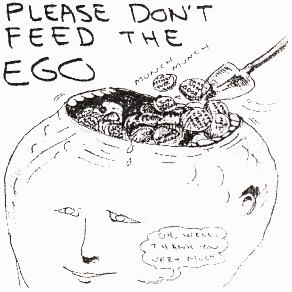
What is the biggest fib that you have ever said? What is the worst thing that you have ever done? When I go to church I usually count the eyes that watch every movement I make. Of course, I always fail to reach the final number. There are a lot of eyes in the church but none is as powerful as the eye that stands inside the golden triangle. That particular eye is so big that it needs a pyramid to sit on. That particular eye likes to look inside your guts; it scans and logs every movement of your organs and it makes value judgements according to the state of decay you are in. If your stomach is feeble it means that there is something wrong in you and into your life. But the eye does nothing about it and the brightest answer it can give is always ‘an eye is made for sight, not for healing.’ Well, of course the eye can do nothing about it because it is just an eye. On the other hand, the eye heals the problems of the soul, that ghostly figure which lingers in every living body. Even dogs have it, cats also, horses, even birds.
So, what is the biggest fib that you have ever said? No, of course you didn’t touch your brother’s collection of stamps. No, you did not forget your keys; it is your father’s fault. No, you don’t secretly hate your grandparents sometimes. No, you have never wanted your best friend get hurt. Of course I have never done these things. Sometimes when I hide things I feel powerful, thinking that lies are bricks that build a wall between me and the others.

‘What is your biggest fib again?’ he asked.

‘What do you want from me?’ I asked back.

‘You can’t answer a question with another question. It is not logical. What I want is fear,’ he said.

So, lies are no longer bricks to build a wall but rather pills of fear. Every time I meet a person I have lied to I swallow another pill of fear, without the glass of water that washes the acerbic taste away. Each lie has that acerbic taste on the back of the tongue. It reminds me of how often I lie not only to the others but to myself. To lie to myself, the acuteness of that particular taste is breath-taking in a very bad way.

‘What do you want?’ he asked me.

I said I wanted the truth and he laughed.

Somebody then told me that I have to accept the untruth as well because it is an inevitable part of our existence. Why does it always have to be the truth? So I made a black lie for me in order to feel better. After all, who am I to argue? Oh, but it is I, the indestructible Ego. Then the wind blew and Ego had nothing left and he didn’t feel so indestructible anymore.

‘There is always love!’ Ego howled.

‘Can you sell love? Can you eat it?’ somebody asked Ego.

Ego thought that love is love, you can’t escape it. You feel it in your soul when it happens. The wind blew again and he couldn’t do anything about it. White lies are made to make the others feel better, black lies are made to make you feel better. Ego waited but nothing happened, not even love.

‘You still have friendship!’ Ego howled again.

No one answered this time. So he stood, famished. Nothing happened. Both love and friendship stubbornly refused to materialise.

Then, Ego committed suicide and still nothing happened. Long speeches were held at his funeral and people said he was a good man and he wanted nothing for himself. Some people said that they shall never forget him and that they shall go to his tomb every day. Once, they were too hungry to go and they left Ego alone again.

I still don’t know what your biggest fib is.

Oh, forget about love, I’m famished. We can love again after dinner.

[Dinner]

Oh, forget about love, I’m tired. We can love again in the morning.

[Morning]

Oh, forget about love, I have to go to work. We can love again when I get back.

[Dinner again]

What is your fib again?

[Love is a black lie.]