One Hundred and Twenty-Five

I took the train back home and fell asleep the moment it started moving. The ticket inspector woke me up minutes later, and I showed her my ticket, then fell back asleep. The sun was setting when I woke up, and in the distance, the sky glistened with gold and victory. When I got out of the train station, the city seemed utterly unchanged. I watched as the same buses came and went; the man who sold newspapers still there, in his booth, surrounded by flashy magazine covers. A teenager asked for a cigarette and was intent on paying for it. I told him I didn’t want his money, but he insisted. I took a taxi to our apartment and asked the driver to let me off at another address. I felt like walking the rest of the way because I wanted to see the supermarket just around the corner, and the antique shop with the expensive Persian carpets on display. The fluorescent sign outside the gym, the coffee shop just across the street, they were all there, like breadcrumbs, to remind me of my way back.

The key still worked. I took the elevator because my suitcase was too heavy and I was too tired to drag it up the two flights of stairs. I could, for once, use the elevator. When I got to the door, I was afraid to unlock it. I waited in the silence of the corridor, hoping to hear something moving in the apartment, but nothing stirred inside. I unlocked the door and the moment I opened it a repulsive smell assaulted me. I got in and closed the door behind me, afraid that it might travel around and disturb the others.

Nothing had changed. My note was still stuck to the fridge. Inside the freezer, tomatoes had rotten to ash. The curtains were heavy with grime and dust, the sink in the bathroom calcified. I left my suitcase in the hallway and started opening the windows. I did not yet dare to go into our bedroom, afraid that it might rekindle painful memories. I knew I could stall the wave of memories, because, after all, I was aware of what they were. I would see your clothes on the bed and imagine you taking them off before bedtime, the yellowish light on the bedside table throwing warm shadows all over your body, the hairs on your chest golden, like gossamer in the morning. I was already imagining everything, with the clarity of one who had understood the situation a long time before and was only playing along so as not to disrupt the natural course of things. I felt like I shouldn’t dwell on those memories, that I shouldn’t go into the bedroom. Not going in was part of that natural course of things. I might have seen it in some movie, the protagonist avoiding certain places, knowing full well that he would be unable to stop some of those memories from resurfacing. To us, in the audience, that always seems exaggerated, a shallow thing to do. But then I was doing it as well, avoiding the bedroom.

I took the garbage out and washed the two cups in the sink. I bleached the bathtub and the drain, wiped the bathroom mirror clean. The water was first rusty red, but then it cleared. The smell inside the house began to change. But I still didn’t go into the bedroom. I went out to the supermarket around the corner to buy some groceries. The cashier recognized me and asked where I had been all that time. I told her I had found work outside the city. Was I back for good? I put the coffee in the bag, then the fresh bread, then the cheese. I didn’t know what to tell her. Maybe, I said, I’m still figuring out what to do with my life. I gave a nervous laugh to show her that I wasn’t too serious about it. She smiled and placed her right palm on her chest. I hope you figure it out soon. I thanked her, grabbed my bag of groceries and went out.

The nights were beginning to get cold, the dying light at the edges of the horizon like a cry for help. The approaching night relentless in its advance. Neon signs competed with the dying sun. Some of the shops lining the street were closing, the owners looking at me, furtively, and with an air of despair, as if I were some sort of alien figure who was a harbinger of a darker age. Cars were idling on the streets around me, people returning from work. I envied them because they had decided to stay in the city while I was running away, from what I don’t know. But the atmosphere calmed me; it made me think of the afternoons after work I spent with you when I was tired but thrilled to see you. The happiness that gave me the energy to spend time with you and laugh with you while music inhabited the background.

I got back to the apartment and turned on the fridge. It whirred to life. I turned on all of the lights, but I still didn’t go into the bedroom. I decided to cook some pasta since it was the only thing I could make on the spot without using too many pans. I washed one of the pots and turned on the burner. The warmth coming from the boiling water made the windows sweat. Finally, it felt like home. I turned the TV on and let it run in the background. I put the pasta in the water and lowered the flame. I wanted it to cook slowly as if seeing it boil brought comfort. I took a bottle of wine out and opened it. The taste and smell of wine made me hungry. I cut some of the cheese into little pieces and placed them on a plate. A man on TV was speaking about immigration. The climate forced people to abandon their homes to move to other countries. They moved in groves, like groups of nomads in search for new ground.

I poured some more wine into the glass.

And there you were, frying the vegetables in a pan, making them jump, the way chefs do on TV. You were wearing a white t-shirt that said ‘double cheese makes life better’ and a pair of black trousers that made your long legs look even thinner. We were laughing, and I was recording you with my phone. It was the evening in which we had gone to a vintage clothes shop to look at some stuff and returned home famished. When we went to the supermarket to shop for groceries, I felt like I was going to faint from the hunger.

Once we got back home, it was already well after nine pm. You held onto the pan with your right hand and placed your left hand on your groin. If there had been a reference into your gesture, I didn’t catch it, yet I laughed anyway because your hair stood in a certain way that made you resemble a very young version of you. Perhaps the little boy who had been told that he was suffering from some sort of syndrome and had to be medicated to keep his body from growing out of proportions. You had told me about him, the little boy, a while back when we said each other stuff one night, and you listened in silence while I told you the story of my life. When you spoke about the doctor and the things he said to you I wanted to hold you tight as if to let you know that the doctor had been very wrong, that you turned out to be the sexiest man I had ever laid my eyes on.

Stay like this, I wanted to tell you, there’s no need to change anything.

Up went the vegetables, and then back into the pan. You were actually good at it. Your glasses were foggy from the steam. Is it a video? I nodded because I didn’t want my voice to be heard on the recording. I can only hear my laughter now. I can see the two glasses of wine on the kitchen table, and I can listen to the music in the background. I remember not wanting it to stop, that moment. I wished the world left us alone, there, in your kitchen. Let us live, and we’ll let you spin, as you’ve done for millions of years.

You were cooking rice or some variation of it. You always asked me what I wanted to eat, but I never knew what to say. You were disappointed by that, but to me everything with you was new, even the rice you were cooking. We fed each other chips and dried veggies while dancing. We decided to eat outside, on the little table you had put on the balcony, where I went for a smoke every once in a while. Before we sat at the table, you cleaned the table. You were adamant about hygiene, and so you wiped everything before use, even the plates you had just taken out of the dishwasher. The water in the water boiler had to be changed before every use because who knows for how many days it had been in there. You had used it that morning, but still, the water had to be changed. You told me to wear house slippers when I went into the bathroom.

You cooked the meat then set it next to the rice on the plates. Then, you lit the candles and placed them on the table. I took small bites, to make it last longer. It wasn’t the food that made the evening resemble perfection, it was the fact that we were there, on the balcony, and the world was watching us. I wanted the world to envy us, to wish to be there with us, or live through a similar moment.

I couldn’t go into the bedroom. I tied a rubber band around the thought.

I heard a noise coming from the bedroom. A thump on the floor. I stood and listened, but the sound did not occur again. I drained the pasta and poured the prepared sauce over it. I arranged it on a plate. Before sitting, I wiped the table clean, washed the glasses, and I, finally, sat down to eat. I did not usually say any prayers before eating, but right then I felt the compunction to do it. Not a prayer addressed to God, no, I had stopped long before that to believe there was a higher power watching over us. It was, instead, the desire to make a wish, as if the plate of pasta was a birthday cake and I had to blow the candles. I wished, most of all, to see you return, to be able to share that meal with you, to let you know that I had mastered the art of making a meal for myself. You were always accusing me of being dismissive of food when the time came to eat something. The truth was, I hated cooking because it required time I did not want or have to dedicate to it. After a hard day’s work, cooking was the last thing that went through my mind. I wanted you, not to love me, I think we were well past that, but to be happy for me, to be content that I had turned into someone you wished me to become.

The rubber band stretched. I couldn’t go into the bedroom.

After I finished eating, I went out on the balcony for a smoke. I found the ashtray with the row of half-naked women on it, which you had bought as a joke. I smiled when I saw it because it was akin to discovering a part of you. The two small chairs with the dark brown pillows on them were still there, as was the little star with the LED light inside that twinkled. When I turned it on, the star lit up and pulsed, but only a few times and then it went dead, or to faint light. A car parked in the courtyard and a man wearing sweatpants came out of it. He did not look up and went into the adjacent building.

I was afraid of going back into the apartment after I finished smoking. It looked so empty and silent from the outside. I put the dishes into the dishwasher and decided to make camp on the living room sofa. I dragged the suitcase into the room. The man on TV was still talking about immigration and the challenges it posed to the soul transfer system. New trends were developing, people asked to be transferred into bodies that lived in the developed world. The notion of citizenship was becoming superfluous. I changed channels. I locked the door and stretched out on the sofa.

Then, I fell asleep and dreamt of my grandmother, who was taking me to an abandoned house. Inside the house, there was a special room that did not have any floors. And if you opened the door and looked down, you could peer into the abyss of your mistakes. I did not see my mistakes, or sins because I woke up before I could do that. But even before I could open the door to that room, I knew what my mistakes were.
How to kill a sobbing heart (88)

my-post-10In the car, Francis did not say a word. He looked, forlornly, out the window at the passing scenery. I put my hand on his knee and asked him how he felt. It’s different now, he said and placed his hand on top of mine. Different, how? I don’t know, he replied, just different. Then he was back in his mind again. I continued talking about trivial matters. The weather had turned hectic. Sea levels had been rising alarmingly, and people were fleeing from the coasts into the mainland. Cities were disappearing. The transition between seasons had become abrupt and unforgiving as if someone up there wanted to see how we would react to that. Have you read Dante’s Inferno? Francis was looking at me now. I asked him to repeat the question. He went on. That’s how I feel, it’s like I’m in beast mode. He closed his fists, placed them together and brought them to eye level, the way children do to mime the use of a telescope. It’s like I’m looking through a plastic tube. Everything is unglued.

Did the therapy help? It did, it made him aware of how his mind worked, it helped him become aware of the plastic tube. I promised him he was going to get better, but I don’t think he heard that. He was looking out once more.
There had been signs; signals, lights going on and off. Martha, who spent the most time with him, told me about these symptoms when we still saw each other regularly. Francis couldn’t sleep, and she would often find him wandering around the apartment in the middle of the night, without knowing what he was doing. He kept asking her, out of the blue, whether she wanted to say something because she was always clearing her throat. She wasn’t doing that, but he heard the sound at all times. People clearing their throats, preparing to say something, which they never did. And he was curious to know, so much, until that curiosity began to eat his guts, and he lost his mind.
The prospect of losing him terrified Martha. Because they had been living together for a while and he was taking steps into directions that unsettled her sense of the world. He would sit around for hours doing nothing, telling her about the things he was going to do. He could find a decent job that was going to make him so people-smart that she will no longer recognize him. She was scared witless. He smoked so much that the hairs inside his nose turned yellow. His teeth, too, because he overlooked oral hygiene. This torpor consumed most of his days. There were good days as well when he would go out and return with a bag of groceries. More often than not he would return empty-handed with a face that spoke a thousand words. She would then fall at his feet, beg him to come back to her. He would smile, fiendishly almost, and tell her that he was there. He wasn’t drunk, he wasn’t violent, he was merely absent-minded. He put the coffee brewer on the burner without pouring the water in it. The brewer burned minutes later. He didn’t apologize, didn’t promise to buy a new one.
They slept in the same bed but didn’t touch. They had stopped touching long before that. She leaned into him, and his attention could only be drawn from whatever was going on in his mind by her clear intentions. He needed to see that she wanted to kiss him, he didn’t do anything on his own volition. He had to be shown how to do it, and when to start doing something. Martha closed herself inside the bathroom when he went on the balcony to smoke, late at night. She cried from fatigue and despair. She was working shifts, and at times she was afraid of going to work, thinking of all the terrible things he might do to himself, knowingly or unknowingly. He could try and make coffee and forget the water again, or forget about the coffee altogether and set the house on fire. She cringed whenever at work she was called by her supervisor thinking that that was it, the call that told her he had succeeded in taking his own life. She also cried, bitterly, because, secretly, she couldn’t shake off the feeling that she wanted to be finally, and irreversibly, free of him. It was going to hurt, a lot, she thought, but she was going to fight through it. She was strong enough to do it.
When she did get the call, that call, she broke down. She went to the hospital, to his room, where he stood, akin to a mummified pharaoh, on a bed of light blue sheets, and transparent tubes. He looked at her from above, and she broke down right there and then, in front of him. This time furiously, pitilessly, charging at him, hitting him, raising her fists in the air. You selfish animal, she howled, and the nurses at the central station turned their heads. The word, animal, akin to a ritualistic combination of words, the demon evoked in need of spiteful words to fully emerge from the underworld, to hatch from that egg of anger. I’m done with you, she continued, I’m tired of looking for you. I’m done with this constant fear, the continuous search for you. A smile played on his lips. You’re right, he said, I don’t want it any longer either. Martha then fell on a chair, next to the wall, and sobbed uncontrollably, because there it was, what she feared most, his irreversible loss in the murkiness of his own thoughts, out of which she had tried, and failed, to pull him. She grabbed her bag and held it to her chest. You’re melodramatic, he said, which also means you never loved me. She froze, her voice still buried in her guts, her legs finally lighter, her fatigue liberated, it danced somewhere else in the hospital room. The fact that you’re leaving me, right here; that’s what it means.
She was melodramatic, she thought on her way out, and he didn’t deserve it, not in the least bit, not even feelings heightened to theatricality. She saw his gesture as one of pure selfishness. He didn’t think of her when he cut his wrists and watched the blood run out of his body. He couldn’t have possibly thought of her when he sat in the bathtub, naked, and filled it with water. It was the downstairs neighbor who had discovered him there, alive, barely, the blood-red liquid that had oozed through the vents, to stain the man’s bathroom ceiling. He was the one who called the ambulance, and he was the one who had called her workplace. He must have left the water running on purpose, she thought, to ruin her bathroom, bring everything down with him, her carpets, let his blood soak everything. She was sure of it.
She got out of the hospital and walked toward the center of the parking lot. She couldn’t remember where she left her car and she stood there for a while shielding her eyes from the sun. She started getting impatient. For the death of her, she couldn’t recall from which direction she drove in. She started walking quickly, then running, then she came back to where she had started looking. Her armpits were dark with sweat. She turned on her heels and still she couldn’t remember. Then she sat down on the concrete, behind an electric panel to hide from the sun. She was out of breath.
The light above her changed, the evening sun was shifting. Heat emanated from the ground and the cars all around her. Another thought crept into her, and it disturbed her because it was unwelcome. Perhaps he was right as well. The fact that she had left him, at a time when he needed her most, was irrefutable proof that she wasn’t in love with him after all. That she had failed.
She stood up and looked around the parking lot. She remembered now. The cafeteria next to the parking lot, the big tree behind it. She remembered parking the car beneath it, in the shade. She walked, and to her relief, she saw the car. And that relief felt so familiar to her. It was as if she had been looking for it for a very long while.


Robb’s Last Tape (Take Fifteen)

FullSizeRender 4

We didn’t have much money when we were little. Once, my brother stole money from my mother’s purse and went on a shopping spree that eventually cost us lunch money for almost a week. He bought lots of peanuts for some reason. I distinctly remember watching the other kids at school eat their wafers and chocolate bars while I only had one apple and a watering mouth. I know now that it was the healthier choice, but you know how envious kids can get. When the teacher wanted to know why I had only one apple for lunch, I told her the truth: we were out of money.

To my astonishment today, I didn’t blame my brother for it. At that time, I perceived it as a form of cruelty perpetrated on us by our parents. They must’ve had money stashed away in some hiding place, money they wanted to keep for themselves. We couldn’t be that poor. To my innocent mind, it was the grandmother’s fault because she was the one who took care of the family’s finances. It wasn’t that we couldn’t afford that new game console, they just didn’t want us to have it. We had to wear the same jacket two years in a row while the other kids got new ones every year. I wore pants knitted by my mother, which I hated because they felt heavy and made me look bulkier.

People in school were mean for no reason. I was bullied throughout middle-school and high-school, that is, ever since I became aware of the fact that I had an ego that suffered when it was deprecated. Older kids made fun of me because I was chubby and studied a lot. Because I was a geek and spent time making mud pies. Some of my classmates derided my inability to run during physical education classes, which I avoided to the best of my abilities. I even had my parents bribe the family doctor to give me a special dispensation for those classes. It wasn’t that I didn’t want to do it, but my grandparents had convinced me that if I forced myself to do something, such as intense physical activity, something would burst inside me and I would die.

Once, I developed my own alphabet and wrote stuff using that. Kids in school made fun of that as well. I kept a diary and brought it to school every once in a while to draft and develop my thoughts. They stole it from my backpack and read it out loud to the others while I cringed with embarrassment. I had written about my first gay crush, who was an older student and a volleyball player. And for all this, the only explanation I could find at that time was that my classmates were inherently evil and that they hated my guts. So I tried to avoid them, get out of class before the bell rang, spend my weekends alone playing stupid online games. My father’s colleagues from work made jokes about my parents feeding me yeast, which made me look bloated like a balloon. My cousin’s grandma once told me I had the head and the ears of a mule. I was called a sissy by random people, on the street, in school, and everywhere I made an appearance.

Casual acts of verbal and physical cruelty were at the order of the day, to the point where even things such as “you shouldn’t sit outside because it’s cold,” took on the tinge of personal attacks. Why couldn’t they just accept the way I was? When my parents went away, I went to live in the city with an old lady (and a cat) who reprimanded me for my slowness and told me to suck it up and act like a man. These acts happened so often that I came to actually give credence to them and reach the conclusion that there was something inherently wrong with me. I didn’t deserve to have friends because I was so obnoxious. With this, there also came the belief that, eventually, somebody was going to accept me for who I was and save me from myself. The only thing to do, I thought, was to find that person and steer clear of all those haters who told me I wasn’t good enough. They were the ones who needed rehabilitation, not I. I was the innocent one.

Since then, I’ve made peace with it, with them, because the resentment consumed me. It still does, especially when I get rejected by someone and I am reminded once again of my own fallibility. It is in those moments that I begin contemplating the idea that perhaps my bullies were right after all. Maybe I am unlikeable just like they told me. Whenever I feel like I disappointed my students, by making an error or by not explaining a concept in the best possible manner, the feeling returns. Why am I even trying? Am I really that stupid to believe that I could actually do it? Yet, whenever this happens, I do my best to develop new ways of halting the stream of negative thoughts at their nascent stages. And it’s not by looking at myself in the mirror while repeating out loud that I am beautiful, that I deserve to be loved, that I am human and make mistakes. I do it by being frank about my fallibility up front so that people around me can identify my mishaps and perhaps forgive me for them, exercise empathy, nurture affection, or just ignore them.

As you can imagine, it takes a tremendous mental effort to do this, and at times panic settles in, and my body starts sending signals of encroaching danger where there is none. I had a severe episode on a Saturday morning in class when I felt I couldn’t go on teaching and had to excuse myself and go to the bathroom because I was afraid I was going to soil my underwear and pants in front of my students. I was out of breath and felt as if my knees were going to topple and I was going to fall over my desk. My heart was racing, and I was sweating profusely. That day, I taught for six hours in this pitiful state, taking frequent trips to the bathroom because I was drinking water like there was no tomorrow, and to this day I still can’t fathom what kept me going, or what, to my despair, was the thing that triggered it. The fear returns every once in a while, but I’ve learned to live with it, and now it no longer bothers me that much.

A similar episode occurred while I was driving the car with my parents in it, on our way to Romania. Our GPS got lost, and my reaction was way out of proportion. My blood pressure swiftly dropped. I couldn’t focus on the road, and I felt my senses receding to the back of my mind while I was desperately trying to focus on my breath. Luckily, I had not entirely lost my ability to make decisions and told my dad I needed to pull over because I was feeling unwell. The moment I did that, and I took a sip of water, I lost consciousness.

I woke up to a beeping sound, which in fact was only in my head, and to my parents’ dumbfound faces. I exchanged seats with my father, and just minutes later, after I had checked whether we were on the right motorway, I lost consciousness again. When I woke up, we were back on the side of the road, and there was that beeping sound still. Reality came back in chunks. First the sky through the windshield, then my mom and dad’s glassy eyes, their voices asking me whether they should call an ambulance. Then the realness of the situation: I had lost contact with reality a second time that day. My chest felt heavy, and my breath was labored as if no matter how much air I sucked into my lungs it just wasn’t enough. What scared me most, though, was the fact that I had uncovered in me this ability to explore, albeit unknowingly, this dark space that was beyond my control, and which ran dangerously close to death.

That summer, once we got to my grandparents’ place, I did a complete medical check-up. Blood tests came back clean. A cardiologist looked closely at my heart, literally, and concluded, somewhat to my chagrin, there was nothing wrong with it, except for the fact that it was slightly, almost imperceptibly, enlarged. I had hoped they could see my heartbreaks, but there was nothing there. Perhaps heartbreaks only make your heart bigger, able to accommodate even more people. Or more heartbreaks. I checked my blood pressure on a daily basis, and it stayed within the prescribed limits. My body was healthy, and all the tests corroborated that conclusion. The verdict was somewhat underwhelming: it was all in mind. My bullies were gone, only to be replaced by a bullying mind, which waged war on my body on a daily basis.

I tried meditation and mindfulness to dissuade my mind from going into a fully-fledged war with my body. My back ached from all those deep breaths I took. There was an urgency to the attacks which confounded me because I felt as if they went against my nature. I had been, throughout my life, a very calm person, so why was I experiencing them? Then, when all else failed, I tried medicating them. My doctor prescribed benzodiazepines, which I took, on doctor’s orders, one hour before my classes, so that the effects of the pills would be clearly discernible from the thrum of my irrational fears by the time I got to class. I panicked when I got on crowded trains, which was almost always the case, and I got lightheaded when I was about to go on a date. I resorted to the pack of pills, whose presence was somewhat reassuring, even when I was about to go out with my friends. My anxiety subsided the way an earthquake would, and I was able to enjoy life once again. I was back to my good old zen self.

The pills emptied me of whatever negative feelings I had. They slowed me down. Reality washed over me in a constant but calming stream, a rivulet really, and everything felt manageable. Whenever I made a mistake in class, I stopped, corrected myself, and apologized. I couldn’t care less about my slips. Yet, in time, I began being increasingly aware of the fact that the pills deprived me of whatever mechanisms I might have developed to work around my issues. They were not a way to do that, the tablets only numbed my feelings, which was akin to me avoiding my bullies in high-school when I asked my teachers to let me out the class before the bell rang. The solution was always the pill. When I couldn’t sleep because of all that constant worrying and dreading, my hand quickly reached for the pills, boxes of which I kept all over the house. I put one tablet in the pockets of every jacket I had, just in case.

I realized that matters were getting out of hand when I had gone out with a friend of mine, and he kept complaining about the humidity ruining his hair, and I was about to lash out at him and tell him that I was on benzodiazepines because I couldn’t deal with reality and he worried about his fucking hair?! I didn’t do it, but just the thought of wounding his ego in that way helped me understand that the medication was beginning to legitimize a side of me I wasn’t ready to call my own: the one that admitted defeat. The part of me which admitted to being unable to work without the pills’ helping hands. The side of me that had given up on trying to recover the calmness with which I had prided myself in the past. It was only a matter of time until I would resort to that chemical succor even for the most basic human functions, such as going to the supermarket or talking to neighbors.

Now, I don’t mean to say that medication is the easy way out of a time-consuming and challenging problem. When it comes to specific mental health issues medication is vital. That is, it saves lives. It helps people lead wholesome lives and prevents them from identifying fully with their affliction. You’re not your depression. Your anxiety does not define who you are. Yet, I believe it is also essential to realize that, in time, it could lead to a defeatist outlook on life, at least when it comes to anxiety disorders. Where do we draw the line between what we do and what medication makes us do? Does it affect our capacity to make decisions? Can we claim full authorship on a decision made while under medication?

Most of us probably know this, but medication does not go to the source of our problems, it only takes care of the symptoms. It sweeps things under the carpet where we can’t notice them, which can be a good strategy, especially when you have a full-time job, or you have to raise children who do not seem to understand your mood swings. It goes without saying that most people don’t understand mood swings because if they can just stop feeling depressed, then you can do it as well. You just have to be happy, embrace positive thinking, and start singing Bob Marley. It also goes without saying that this kind of advice is likely to make things worse because it implies that if one can do something, then all of us should be able to do it.

Over the past year, while dealing with my anxiety and panic attacks, I have also tried to identify as best as I could moments in my life that have led me to where I am today, but that’s always a difficult task. Most of the times the things you think have left a mark on you are not the source of your problems. It might be something else entirely. The abuse that was not perceived as abuse when it was perpetrated on you. Family issues, an alcoholic father, an opprobrious uncle, or a cousin whose sexual appetites were too developed for his age. It can be any number of things, and there is no right or wrong answer in this equation.

I always return to my bullies, which might be my easy way out. It might be that I’m giving them too much credit where there is little credit to offer, or where there is none. I also keep having the nagging sensation that my lingering on the high-school episode might be merely an obsession I have developed over the years and that it might be high time to just let it go. My bully-narrative does fall in line with the current craze for tales of redeeming à la Oprah Winfrey. We’re all looking, it seems, for a traumatic past that would explain why we are the way we are today, to be able to say that, yes, we’ve suffered, but we’ve managed to overcome that. Just look at how far we’ve come. And perhaps I’m vilifying my bullies the way I belittled my family when I felt like they weren’t giving me the things I wanted. I need them to be evil to justify the damage I seem to be doing to myself or to be able to say that the image I have of myself is beyond recovery because of that.

It’s astonishingly easy to vilify those who hurt us, or those who do things we perceive as hurtful. It’s as if we’re hardwired to do so, trained to expect instant gratification even when the rules of the game do not even mention it or are vague with regards to that. The slightest offense, such as reading a text without replying to it right away, triggers waves of resentment. Not getting a like on Facebook from a specific person is often interpreted as an indication of a friendship turning cold. Each gesture, even the most unconscious, is thus soaked with intentions that are, in most cases, detrimental to our mental wellbeing, deprecating to our egos, disrespectful of our investments, be them emotional or physical. The road from peace to fully-fledged war is a slippery slope.

This summer I met a guy I really liked, and it all seemed to work well between us. We both love books and reading, and so we always had something to talk about, albeit our tastes in literature were diverse. He likes Italo Calvino, while I find him cold and distant at times (though the guy swears that it’s not so). I love Faulkner and other authors he has never read, and probably never will. But that never got in between us. The first time we went out we had drinks at a bar in Piazza Vittorio Veneto, and we instantly liked each other. We discussed Camus that time, and in no time we got to touching hands and looking at each other with dreamy eyes. After we had drinks, we bought beers and went to his place and listened to music late into the night. We talked about Virginia Woolf and, of course, we kissed (and…did some other stuff as well; I won’t go into details). Then it was time to go because it was getting late, and he accompanied me downstairs, and we kissed by the main entrance knowing that there were surveillance cameras. We felt rebellious because, I think, we had uncovered something in each other we both liked. I took a rented bike and rushed to the train station all sweaty from the pedaling and the unusually warm night. But I felt happy.

We decided to meet again, and when I went to pick him up from his apartment, I immediately noticed something was off. We had drinks at a different bar, and we grabbed something to eat, and then we took a long walk on the banks of the river Po at night. And we had THE talk. He liked me a lot, but he was unsure about it, because he had felt the same way about his ex, and it was happening all over again, and he didn’t know how to deal with it. He was happy about seeing me, but then he saw me and felt doubt creeping in. I felt humiliated and embarrassed and told him I was going to go because the discussion made me uncomfortable, and it reminded me of other such dates, which had not worked out and they only made me feel bad about myself. Yet, he told me to stay and talk things through. We did discuss things through, and his doubts seemed to recede. My doubts did the same. I have always been of the conviction that whatever issues we might encounter in such cases there was a way out, a compromise that would make things work.

We met, repeatedly, and then he had to go back to the south for the summer holidays. We talked, every day, exchanged ideas about books and writing because he is also a writer in the making. He got jealous when I commented on other guys’ pictures on Facebook, and he told me so. I was happy with that because, finally, there was a guy who likes me the way I am. Then the ominous silences began until I couldn’t take it any longer and demanded an explanation. He told me he changed his mind and gave full swing to his doubts. He was no longer interested in pursuing whatever we had because he never really liked me in the first place. I’m an exciting guy but physically not that attractive, and so he had decided we could stay friends.

I tried crying but couldn’t. Tears never came quickly to me. A friend suggested I took a shower because showers made him cry when the situation required it. I tried writing but couldn’t. I walked around my grandparents’ back garden trying desperately to muster the energy to scream, to be furious, to kick things, punch holes through the walls. I turned the music to full volume hoping that in that way I wouldn’t be able to hear my thoughts. What did I expect? Why had I trusted this guy who was, ultimately, just like everybody else? I should have known better! I tried reading James Baldwin to calm down, but nothing helped. The heaviness in my chest returned, the shortness of breath, the lightheadedness. And all I wanted to do was tell this guy that he was a douchebag. I felt betrayed, sad, and alone, and most of all, I saw my old fears confirmed. My bullies had been right after all.

I didn’t tell the guy any of that stuff. Resorting to negative feelings, I had come to know, was akin to reaching for the pills. A quick way out that would have closed the door behind me forever. And I didn’t want that. Deep down I hoped he would take his words back and we would get back together. So I kept all that resentment to myself. Then, when we met after the summer something was definitely off. He kept squinting at me as if he couldn’t understand what I was talking about. He was overdoing his gestures, he laughed theatrically and somewhat nervously. He was intent on showing me that we had lost whatever spark there was between us. To this day we still exchange texts every once in a while. A couple of days ago he sent me a picture of the cover of a book which had made him think of me, and that makes me happy.

Yet, my initial reaction was to vilify him. I wanted him to sense my resentment and feel sorry for hurting me. I wanted him to feel sorry for himself. And although I thought of him in this way at that time, now I realize that it was only a deviation from how I honestly feel about him. I still experience that warmth in my chest I felt the first day we met when I think of him. He may feel differently about this whole situation, yet I choose to stay true to my feelings. I will most likely never know how he felt. I only hope we worked things out, in the best way, for both of us. Resentment returns, of course, and often when I see him on dating sites, I get jealous and imagine him going out with all those guys. But that feeling is only a feeling that is not mine to have. He made his choices. I made mine.

And that’s that.

I saw his best friend today, on my way to class, and I was reminded of him. The same friend in front of whom he had kissed me once when we met on the street, back when things were still going well, and I was full of hopes, and I couldn’t look at other guys. And a wave of bitterness washed over me. And I took a walk. I often doubt myself, yet I refuse to believe there’s something wrong with me. I’m sure he had his reasons.

Architectural Design (sneak peek III)

[Beginnings]

On the way to the shop, the sexless child, like any sexless child, fell from the sky in the village of grandma and into the arms of an overweight priest who tried drowning the sexless child in abnormal water. On the way to the shop, the child fell on knees and elbows, breaking the skin. That’s when the child acquired a gender. The sexful child became he.

Such joy. A boy to carry the name on his shoulders. A name like a dead body.

Wait. Or perhaps some internal animal, eager to come out, tricked the child into falling on his knees and elbows to make the blood come out. It was the devil that the overweight priest tried to wash away with the abnormal water. The blood came out, first shyly then stubbornly, like a playmate who refuses to leave. The child ran back home crying and the child’s father suggested he wash his wounds with soap. The mother disagreed and instead placed the child on her extended legs, rocking him from side to side until the pain subsided, so that the child faced the womb and go back the way he came.

But the child did not know how to get back.

The child had to wait for the wounds to heal. The skin around the wounds turned hard, then brown. The child looked forward to peeling off the hardened brown skin and so, to make the time pass, he played on soft grass, and read books on a blanket in the garden. The child used to look at the sky and think of it as the glass belly of a bottle. Then the day would finally come, when the brown hardened skin revealed the pink fragile skin beneath, the incarnation of an embarrassing kiss or of violence discovered at a later date. That other skin would harden, again, and fall, again, imperceptibly.

The child was an animal. Really.

Not unlike any other animal in the schoolyard, but somewhat different, more like a frown on an adult woman’s face when she sees horse shit on the side of the road. Indeed, more like a fart that everyone heard. This animal broke a sweat every time he masturbated.

[The shape of the sky is the shape of your life]

The houses were the same. They were painted differently, according to the taste and financial means of the owner, but they had the same look. Two big rooms with small windows. A kitchen, at the back of the house, to be used only during rough winters. The kitchens had slanted ceilings. A storage room that housed fruit and was dark enough for monsters to live in it. And an attic, where clothes were hanged to dry during the winter.

In those houses they slept, and fucked, and ate their lunches and every other meal.

The blue blue sky so unavailable. The grass, our grass, on late November mornings like hair parted to the side. Those mornings like the amber droppings of cherry trees. The ground beneath their feet so sterile that the neighbors’ grapes were sweeter. The cherry trees refused to grow and only gave them limited access to their fruit. Some rituals had not been performed properly, the ground too young to give birth to anything appealing except perhaps for the children who needed to be kept away from harm. The world beyond the front gate so evil the children had to jump over the fence and endure the bruises that flowered between their thighs. The bruises that mother would discover when she washed them on Wednesday and then on Saturday.

The trees fell from the sky like strands of hair. Grandma brushed her hair in the morning, the hair she dyed only just above the forehead, the side of the head that was most visible from under her headscarf.

The trees the children climbed to steal fruit or simply to bypass fences. Cherry trees were particularly precious. Old men guarded them with sticks and stones and if you dared to steal the fruit you ended up with a good beating.

The hair at the bottom of the sink. The hair mother found on dad’s clothes asking whose hair it was. This is not my hair. My hair is not as long as that. The condoms that mother found in father’s winter coat. About which we heard but hadn’t heard.

In winter, mother smoked by the stove, the smoke getting sucked into the puzzled mouth of the stove. She was trying to get father’s attention and she threw a box of matches at him. The box flew through the room and hit father in the groin and when the children were not looking, father made a face, and in that face the child saw their adolescence, and how adults were not the adults of books or the adults they saw on TV. These were not the adults who set on voyages not knowing where they went to seek cure for obscure illnesses. These parents were the parents who were content with what little they had.

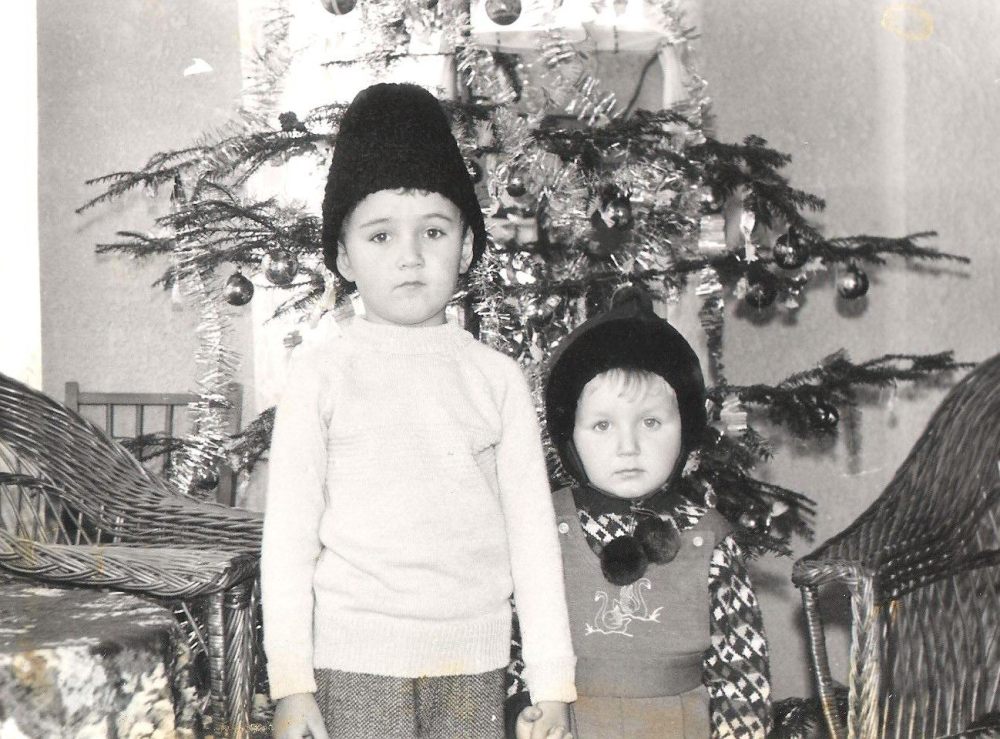
The rooms had to be big enough to accommodate numerous families. To save on firewood, large families could crowd in one of the rooms. Most often, the other room was used as storage. And Christmas trees. Since Christmas trees had bars of chocolate on them, besides the twinkling lights and other merry paraphernalia, they had to be kept in cold rooms. Not because of the temperature, of course, the chocolate bars didn’t melt easily, but because the children had to be kept away. The tree was there for the pictures. Which we took with large woolen caps on our heads and heavy sweaters that were as itchy as they looked. We didn’t go in there. We just knew we had a Christmas tree in a part of the house that was inaccessible to us.

The other room was also where the good clothes were stored. People and clothes had to be separated that way. Clothes needed their intimacy as well. Grandpa’s heavy leather jackets were particularly shy. Like distant relatives, they were brought into the habitable room only on the nights preceding special events. Such as going to church. And like distant relatives they brought with them a smell of their own. The smell did not conceptually belong to grandpa. His heavy leather jacket, the suede kind on the outside, with white sheep hair on the inside, occasionally smelt of aftershave and deodorant. That wasn’t grandpa’s smell. His smell was that of chewed and digested grass and hay. His smell was that of sheep. Little lambs, that were sometimes brought in the house during cold winter nights. We visited them in their shed and took the smell with us. We didn’t mind it, of course, we knew no other, better, smells.

What did you expect? We were used to seeing our own shit, and that of the others in the household, steaming in the outdoor toilet on cold winter mornings. If you had to take a dump late at night or, even worse, in the middle of the night, well, good luck to you, my friend. No matter how well you dressed to withstand the thermal shock of going out at night after spending hours in an overheated room, your balls suffered nonetheless. You had to pull your pants down. In a tiny wooden shed where even your breath turned to steam. Constipation was a drag from so many points of view. You gave up easily because of the cold. Your ass froze. And sometimes a rat would appear and drown in your own shit-and-piss.

The houses were all the same.

Sad mothers grew up in them. At dinner, the men in them ate their souls and they grew like skyscrapers. They grew to become big strong men, so strong that even their convictions grew stronger in time. Their heads turned hard.

I rarely put things on my head. My head is big enough. If I put things on my head, such as a cap or a hood, my head is bound to look bigger. Hence disgusting. Nobody wants to feel like that about their heads. Unless there’s something going on in your head, unless your head is messed up and the only thing that can make it right is reprogramming, the traditional brainwash, mental shampooing. Use a soft piece of cloth for the eyes, you don’t want to scratch those LEDs, miss the high definition.

But when I do put things on my head, and then take them off, I need time to realize there’s nothing on my head. I put my hands over my hand to tell my brain there’s actually nothing there. My brain eventually gets it. My head is really free and surprisingly small, less disgusting.

When I was little a log fell on my head. I started running home the moment it happened. The other kids stopped me and told me to calm down. My head was alright, they said, and they put their hands around my face. My brain understood it was still in one piece. It was a big log. If I were to put my fingers hands around it my fingers wouldn’t touch. Not even close. I knew the log was going to fall on my head so I stood underneath it, to see how it felt.

When the log fell the pain at the top of my head told me to stand my ground. It was the full stop at the beginning of every sentence. My feet dug into the ground and since then I’ve been swimming in the dirt. The other kids didn’t want me to tell. They encouraged me to stand under the log and see it fall on my head.

The log was part of a homemade contraption, engineered by the grandfather of my cousin who wasn’t actually my cousin but it was nice to think of her as cousin. We had a swing made of wrought iron and the cousin got really jealous and she told her grandpa she wanted one as well. He put the log in between two trees and tied a thick string to it in the shape of a swing. A wooden board with two half holes at each end made sitting on the swing comfortable enough to satisfy the whims of a little girl. If you swung long enough the log would rotate until it fell out.

Nothing happened, except for the swimming-in-the-dirt thing. My head got bigger because of that realization. My ears got big as well, to fit the size of the head.

‘Your head is so big,’ my cousin’s granny said, ‘you have the ears of a donkey, and your brother’s life will amount to nothing.’

‘You stay away from her,’ my cousin’s grandpa said, ‘go home and leave her alone.’ He was trimming the trees on the street and I was just a little boy. I took my oversized head and went home, which was not very far away because we were neighbors.

On the train, on my way to work, much later on, I thought of what I saw that day while returning home. I saw mountains growing on the inside, their snowy peaks like those of homemade bread, then breath in between them, porous shame, like that of broken shoes.
A big head should house many things, even the unnecessary. But it cannot remember what happened to the toy stolen but not really stolen from grandma’s house. The grandmother on the father’s side had a house unlike our own, and in it there was a room that had no power outlets and no lights, no heating implements. The father’s twin brother and his wife slept in there even during the winter. They warmed the pillows and the covers before going to bed. They tucked themselves under the heated sheets and they slept.

In the house there were toys very different from our own and one of the cousins insisted I hide one of them under the shirt and take it home. But then, a couple of hundred feet from the house the toy disappeared.

I expected, even after reality set in and I finally got home, the toy to fall from my shirt and reveal itself.

How could a head so big forget about the toy?

‘Your head is so big,’ a classmate told me in high school. I moved to one of the other beds in the room. Where else could I tuck my head, renounce this huge house of dreams?

My father’s car got a remake and was painted in a putrid red, the color and the texture of overly matured grapefruits. The underweight neighbor whose husband lost his mind came and marveled at it the day after it was brought in from the repair shop. She must have marveled at how much money went into that paint. At times I went in the car to listen to music on the radio. The car then became a big pair of headphones. I listened to Hotel California without knowing what it was or why the musicians had decided to dedicate the song to a hotel.

The backseat was the most fascinating part of the car because that is where the goodies used to sit. Bananas mostly, chocolate, and yogurt. When the backseat was empty it was a disappointment. It happened one of my birthdays when father didn’t bring anything in the backseat. I was showered with gifts a couple of days before my birthday but that didn’t matter. Those gifts didn’t count. I wanted that game console that resembled a computer keyboard. I could write on it. Play word games. Which I didn’t play in fact, because they were boring. But just having the possibility to play that kind of games made my desires go mad.

I was around my school in the afternoon and I saw my father’s car returning home and he stopped and I got in and the backseat was so empty I wanted to cry.

At home I sat on the front steps of the house and acted real sad.

I told my father about the game console and he assured me that it was coming in the next couple of days. My father, the traitor, the unloving father.


Donation

If you enjoyed this post, please consider making a donation to support "The Doubtful Recluse".

€5.00

Robb’s Last Tape (Take Thirteen)

Barbie and Ken

A reading by the author:

I used to play with dolls when I was little. And they were always somebody else’s dolls because boys should not play with dolls. When mother or grandmother caught me in the act playing with them I was told, in a half-scornful, half-playful tone that made me cringe with shame, that my pee-pee would magically detach itself from my body. Imagine the dread of a boy child being told he would have to live with the stump of his dick for the rest of his life. When caught in the act I would make the dolls fight because that was what boys do. They make women fight over them.

To begin with, we didn’t have many toys to play with because my family thought of them as a waste of money. We were encouraged to do something else instead. Play with sticks and pretend they are horses. Play outside, for god’s sake, use your imagination. Take the cow for a walk if you have too much time on your hands. Pick some beans. Do your homework. And whenever we admonished our parents for their heartless refusal to buy cool new toys we were consoled and told that, in a distant past (one I have not, up to this day, managed to salvage from the wreck of my childhood memories), we had plenty of toys. We had been so lucky back then, mother would say, as opposed to other children who had had nothing. Allegedly, we even had this fantastic toy bus that had horses riding the wind on the top of it. Fucking horses on the roof of a toy bus. And I was drawn, as if by a magnet, to that image of the toy bus, and imagined how cool it must have been to have that bus to play with. Literally, we must have been the coolest kids on the block. To this day I do not know what color that toy bus was. I often think it was just a figment of my parents’ imagination. The toy they would have liked us to have but never got to actually buying it.

All of those toys got lost due to my parents’ negligence when we moved to grandparents’ house at the countryside. They were all on the moving truck when a thief decided to kidnap them and keep them for himself. The thief’s only ransom was, I believe, the innocent suffering of my brother and I. We were infuriated back then by the thief’s cunning and cruelty and imagined him to be the very incarnation of evil. Because of him, we had been cursed to make do without those toys. And we did our best. We scavenged for toys in the garbage dump behind our house. We played with discarded lighters from a local bar and marveled at the mechanism that made the fire burst and die out. We broke bear bottles by throwing them against the trees. We lit fires and threw pressurized spray tubes in the flames and watched them explode. One time we gathered around a burning plastic barrel and watched it collapse within itself as the fire melted the gray plastic. Then one of the kids pierced it with a tree branch and as the branch flexed it threw molten plastic on my face, around my mouth, leaving red burn marks. As I flew in terror from the still burning barrel I was more afraid of my mother than of the stinging pain. The marks lingered for a couple of days then disappeared.

We climbed trees and ate crab apples. We looked for my uncle’s porn magazines under his bed. My brother started smoking and did his best to mask the smell. We ran away from home to bathe in a nearby river because everybody was doing it. But mostly, I played with dolls. I loved the blonde hair they had and the chemical symmetry of their bodies, their plastic immobility, the limited number of movements their bodies could perform. They had breasts but no nipples and I was totally fine with that. The space between their legs so devoid of any gender signals as if whoever made them stubbornly refused to give them that, afraid that it might corrupt the minds of innocent children. Their septic bodies refused to cater to any kind of sexually charged gaze. Yet, back then, I believe, we were entirely conscious of that absence. At least I felt there was something missing but was too afraid to say it out loud. I was also aware of the missing nipples. I knew perfectly well that girls had nipples too. But despite that knowledge of the missing nipples and genitalia, we were somewhat content with the surface gender markings. The dolls taught us well that it was all about what was on the outside. Womanhood meant having long blonde hair, breasts that protruded only slightly through the diaphanous dresses they wore. Women wore bright colors, they had lipstick-red lips, they had ponytails, they had tea in the afternoon. It was all about their bearing as it was all a bottom-up approach: you put all these characteristics together and what you get in the end is a woman. The technique worked for men as well.

The dolls were not mine because it would have been a sacrilege to have them around the house. I dreaded my brother’s mockery, I feared my mother’s scornful tone. And so I befriended girls instead of boys. They did not laugh at my body, they did not tell me my head was like a giant pumpkin. They seemed to be okay with it. And they had dolls to play with. My best friend was a girl. She was a distant cousin of ours from the city who only came around to spend the summer with her grandparents, who were our neighbors. We played Sailor Moon together and built tents and made mud pies imagining we were making cheese. We watched Art Attack on a German TV channel and tried to use the tricks we were taught by the show’s presenter. And at times, when we were on the rope swing in the backyard, we realized (at least I did) how common our interests were. Sometimes I think that the people who saw us playing together must have imagined us getting married at one point. At other times, considering her parents’ blatant skepticism when they saw me stopping by to ask her out to play, I think those same people also feared that I wasn’t fit for the husband-job thing. I wasn’t, for, now, obvious reasons.

We did get married. My brother performed the ceremony on a summer evening under a cherry tree. We had picked flowers and we had a white gown made out of curtains, and, for some unclear reason, when the ceremony was over I was so ashamed of myself, as if I had trampled over some sort of sacred ground that was off-limits to us children. I was a boy and she was a girl and in this dichotomy the future is always easily foreseeable. All stories ended in that way, with the happily-ever-after that comes with marriage, and there was nothing we could do about it but play our parts. Yet, as time went on I failed to develop any kind of sexual interest either in her or the girls I played with. While the other guys in my alleged group of friends started talking about the pubic hair of girls (for some sick reason, always better when “parted in the middle”), I stuck to my dolls and books. I simply thought that my time would come at one point, and I would wake up one morning unable to think of anything else except the pubic hair of girls, always best when parted in the middle. (I almost laugh as I write this and it’s the kind of laughter that nestles in my chest whenever I hear bullshit. This is all true.)

To drown my post-marital shame I put the gown-wannabe over my head and pretended I was the bride, fooling around. That was not the only time I pretended to be a woman. When I was alone and had nothing else to do I used to go through my mother’s wardrobe and put on her dresses and high heels. I would look at myself in the mirror, sing and laugh, walk in my mother’s shoes, put my hands on my hips the way women did in movies. I put lipstick on because that was the only thing my mother had in terms of make-up. I put all those elements together and for a moment I was a woman, catering to the male gaze in my own childish ways. I imagined myself on stage until at one point, in high-school, I literally was on a stage, blinded by stage lights, wearing women’s clothes. It was a play, of course, but perhaps, deep in the well of my solitude, there was a moment when the boy who was my husband on stage seemed to me more than the empty shell of memorized lines. (He was very cute, by the way, and he was a dancer.) I can still hear the burst of laughter coming from the audience when I entered the stage wearing this huge dress, all glittery and lace, and volume. My voice sounded so removed and distant when it came out through the speakers. But I knew my part well. Put all those elements together, and you’re a woman.

After the show, the girl who had applied the make-up told me, as innocently as she could, that she had forgotten the make-up remover. I washed my face as best as I could but the eyeliner and the powders she had applied were all waterproof and so I had to ride the bus back home with clear traces on my face. I noticed the stares people were giving me but for some reason I chose to ignore them. I was not going to have my big night ruined by them. I floated, crossed my legs while sitting, and dreamily watched the moving world through the windows of the bus. You’re wearing make-up, a man told me later that night, and the words seemed to freeze on the spot, as if the asymmetry of my appearance (a boy wearing make-up) took too much space in his head and he needed to cease all motor functions. I felt powerful. Not because of the make-up, but rather because I had had the courage to get on stage like that. Or perhaps I’m saying this last bit simply because I was ashamed of it, or because I’m still ashamed of it. Boys don’t play with dolls. Boys don’t wear make-up. And when I look at the photo that was taken backstage before the show (me wearing that huge nineteenth-century dress, standing next to my high-school English teacher) I still feel the uncomfortable giddiness triggered by the laughter in the audience. Perhaps that is how acts of courage feel like. You tell me.

In another show, in a different setting and on a different stage, I wore a wig that fell off in the middle of an important scene (when I was confronting the man who was supposed to strangle me in my sickbed). The make-up was minimal but the role fit like a glove, or rather unlike my wig. I was a damsel in distress and there were only two men in the play, both of them helpless and useless. One of them was my absent husband, who was most likely having extramarital sex (I don’t blame him, I was a chubby high-school kid wearing make-up after all), while the other one was my supposed killer. I shot the latter in the end, with a gun I held hidden in the folds of my bathrobe. Imagine the kind of treatment the husband must have gotten upon his return. [wink]

Then I got married again. Somewhere off stage that is, because the play began only where the happily-ever-after started, the honeymoon. Yet, this time I had to play the loving husband and, well, it didn’t go that well, as you can imagine. In the play I was supposed to be this womanizer whose ex-girlfriends showed up at the cabin in the woods where the honeymoon was supposed to happen. Then a woman in labor showed up (the baby was not mine, go figure) and another man, and then some other people I cannot recall right now and it all ended with a big party (and me ironing shirts while Frank Sinatra’s Love and Marriage was playing in the background). It was a comedy, but even in a comedy I could not play the part of the loving husband. I had no attraction towards my wife and I guess that is why marriages fail to work. I tried putting the elements together but the loving husband failed to materialize. I faked it till the end but the faking was transparent, so much so that after the show, when we were given feedback by the jury one of them told me I looked gay. (He even made the voice and the hand thing that were supposed to be the kind of gestures a gay guy makes.) I felt ashamed of myself. Put a failed loving husband together and what you get is a gay man.

It was not the only time I felt ashamed of myself. Once, during a trip in high-school a guy on the bus told me I acted like a girl. You are so girly, he told me and his companions laughed. I only wished to make myself small and disappear from the face of the earth. On another occasion, and in a period in which I had become enamored with Duncan James (the hunk from the English boyband Blue), a classmate loudly commented in front of the whole class on my habit of staring at pictures of him. You like those boys, don’t you, they’re very good-looking, he scorned me. I went all red in the face and told him to leave me alone. I told him they sang beautifully, because in situations like these that was my only exit. Pretend you love the art behind the beautiful face, pretend you admire the work, never the person. Pretend, pretend, pretend. It’s so easy, do it like I do it and before you know it you’ll be a real man. This is what you do: you scratch your balls, you put your hands in your pockets like this, you place your feet like this, firmly into the ground as if the ground beneath your feet belongs to you.

There’s a tiny recorder in your head, taking all of this in, and the words wrap around you the way a rubber band wraps around your finger until it goes blue.

A boy doesn’t talk like that. A boy doesn’t walk like that. A boy shouldn’t like flowers. A boy doesn’t hold his hands like that. Why can’t you just like girls? Have you at least tried it? As if liking girls is just a matter of how you like them. Tall, short, blondes, brunettes, spicy, sweet, take your pick, just don’t stray outside the chalk lines or the lines in the sand. I felt as if I was in one of those video games where there is only one exit and the other doors are closed; as if somewhere along the game I had not made that one thing which would open the door to the next level. I had not collected all the diamonds and the coins and I was stuck there, thinking of restarting the game. Or just quitting the game and be done with it. Because what happens when you are told that you are off, that your body does not correspond with your bearing, is akin to being told that you do not deserve your body, that you’re wasting it in view of something that only goes on in your mind, and is therefore wrong, crazy, sinful, stubborn, a vice, damaging.

Other men should make you sick. Their smell should be repulsive. The very thought of it. You’re in the army now.

Start recording, you’re told. And you listen. Because you want to belong, to be a part of something, to have friends, to be liked. Until your mind becomes a catalogue of gestures and postures. Keep the tone of your voice in check, lower the pitch, baby, let your manliness sing in the ears of your interlocutors, make the world shudder with sexual anticipation at the sound of your voice. Make women wet with your gait. Push your chest forward, spread your legs when you’re on the bus, and when you become impatient with something show them that you are impatient by shaking your feet. Puff, show your jealousy, show them who you are. And somewhere deep within your guts a part of yourself is slowly starving akin to a worker on hunger strike.

This circus training goes a very long way. You become aware of it even in the circles of people who are supposed to understand this, who are supposed to fight alongside you. A couple of days ago, I was asked, rather nonchalantly, by a guy on a dating app, whether I am manly. He’s manly too, he says, but, don’t get him wrong, he has nothing against effeminate guys, in fact, he has a lot of effeminate gay friends (does that ring a bell?). He can’t stand being seen with effeminate guys because that would be akin to wearing yourself on your sleeve and there’s a world of wrongness behind that. He doesn’t exactly say that but that’s exactly what he’s saying. I don’t really understand him, but maybe I do. Maybe I want to tell him that his preference for manly men (whatever that means) is simply a cover-up for the fact that he is uncomfortable with his own homosexuality. There are only so many ways in which a man can wear his make-up. I don’t tell him this, because he’s cute, because I’ve fucked up for so many times that I don’t want to do it again, because he likes my profile. Because, because, because. Because I’m not usually a magnet for guys as cute as him.

He is not alone in this. There’s a long stream of guys who advertise their manliness either by flexing their biceps or by saying it out loud. Manly guy for manly guys. I’m just a simple guy. I’m just a normal guy looking for other normal guys, which is secret code for straight-acting/straight-looking guys, therefore not gay, because being gay is unruly, it’s the drawing a child makes, the one in which people’s heads are too big. I want to tell them, honey baby, you like dick, and no straight-act you put on is going to change that. But I say nothing because sometimes I’m afraid of dying alone. I make brownies instead.

For once, just let it go.

I am feminine, though at times I take pride with myself when other people tell me that they would have never thought I was gay. I hide well, I want to tell them but I don’t. I might move my hands a certain way, with the elegance one rarely sees in other men. I have feminine traits. My doctor once told me I have feminine hips. And no matter what I do, no matter how much I work out, no matter how much muscle mass I put on, there are certain things I cannot change. I have my mother’s face, which at times resembles that of porcelain dolls. As I write this I feel the urge to tone it down and add “but not that much” every time I say I am feminine. And perhaps that is the problem. Perhaps the problem is with all these adjectives.

These are my hands. I can only move them this way. This is the way I speak. These are my hips. This is my face.

Robb’s Last Tape (Take Eleven)

29372861

I’m most afraid of you when you take off your glasses and your eyes appear misplaced, too close to each other, and I wonder, do you know that I hide behind something as well? As we sit and talk over lunch in the university cafeteria, our voices slightly above the general thrum that threatens to drown us, I watch you move fork and knife over your veggies and chicken and see my brother’s hands. So familiar in flesh, I almost want to touch them. In this watchful state I feel like a predator waiting for you to say something revealing, if not about yourself then at least about us. Is this okay? Does it feel good to be this close? Or should I move farther away from you? Where do I stand in this equation of loss and gain?

Then again, it was you who said we should have lunch together. 

But even before the white plates still warm from the bellies of industrial dishwashers, and the lunch and the yogurt I call pudding, as we walk towards the cafeteria, I see a guy who resembles someone who wrote to me a couple of days before. There was not much of an exchange, but from the pictures he had sent me I know it is him. I know I had seen his dick in two consecutive pictures. An erection seen from two different angles (a case study, really, in the wonders of male genitalia), next to a picture of his face. Do you want to feel this in your ass? That’s what he wrote to me after the pictures and I wondered why the face? Is there a dialectics to your body I should take note of? Face, then dick, then dick again as if, in quantitative terms, your erection has a higher rate of success. I did not reply thinking that it would have been barbaric to do so. And as we pass him on the street, we look at each other and recognize each other, and later he visits my profile on that dating app as if to make sure that it had been me, in the flesh. Yes, I wanted to tell him, you saw me and I saw you. I saw your dick and I was not impressed. I had seen you the other day having lunch in the cafeteria with a girl and a guy wearing white overalls. Has he felt your dick inside his ass?

At times, I think there must be something wrong with me. How could you say no to a dick like that?

Then there are others whom I do not recognize as I walk through crowds of people on my way to the cafeteria. I don’t see them because I had not seen their faces. I only saw the beard in the picture and the mouth that wrote ‘would you like some dick as well?’ I said yes and felt ashamed. I wanted to hide. But the guy replied. ‘Meet me in the bathroom.’ Which bathroom, I asked. The reply never came and I imagined he must have thought I was somebody else, perhaps the guy across the aisle in the library who couldn’t keep his eyes buried deep in the books he was reading. He must have been disappointed.

If disappointment could grow a body, my body would look like it.

Of these things and others I think about while I watch your hands hover above the plate. I think of how different our worlds are, and not only because we’re citizens of different countries, in a country that is neither mine nor yours. I think of how, in this world of sex and erections seen from different angles, none of us could ever attain the elegance with which you move. We don’t have the long strides you take with each step unless when we’re running from each other. The white shirt and the leather shoes, your manners, the way your English comes our of your chest as if calling for attention. We’ve abandoned courtship because, unlike you, we’ve been trained to take as much as we can when we’re given the opportunity. Meet me in the bathroom where nobody could see us. The bathroom stall insulates us from the world. There isn’t time for intimate discoveries here, because anytime soon somebody might come in and take our decency away. Here’s my dick, let’s get to the part where we enjoy each other and then leave.

So, I’m taking from you as much as I can. I can only steal the things I like, because I have no currency to give in return. I’m taking your laughter, and the way your lips move when you talk. I’m taking the white shirts and stuffing them here. I’m taking the way you say my name when you’re asking me what I’m up to. I’m taking our conversations. And I’m never giving them back.

‘Tis the season

326243_1920217446915_6287202_o

It’s always been the same. Christmas. It’s always been about the food and the awkward moments clustering around the notion of food: the family moments, the pictures, the Christmas tree (always missing something), the gifts, the excessive drinking and overeating, the idiotic jokes, and the sudden jolt of recognition that we all are mere shallow human beings who are bound to make mistakes. And like all creatures of habit we’ve turned all this into a celebration of habit. Christmas is the excessive salivation at the sound of the bell. It’s the constant worrying about those extra kilos and the mother-in-law who thinks everything is inappropriate. It’s when food is served with fear. It’s about dad’s jokes, the ones that deep down, hidden between folds of carefully chosen language overheard from other conversations, hide a darker truth, one that always ends up being sexual. It’s about those other people stopping by and about their crinkled noses when they’re offered another piece of homemade panettone. They’re so full of it. I mean, just look at them. And it’s about dad telling them that from the waist down you resemble him. Why would he even say that?

Christmas is also about friends coming over. Those people who are not really your friends because, believe me, there had been a time in their lives, a time as long as a moment’s beat, in which they disagreed with something you did but never had the guts to tell you so. It’s about their sexual frustrations. And yours. Gosh, it’s never been about the birth of Jesus Christ or whatever. That’s just an extended commentary, a side note to whatever we do at this time of the year. That’s Hamlet’s soliloquy, the one that doesn’t push the action forward but doesn’t bring it to a halt either. It’s something that we know by heart; it is etched into our daily lives so much so that we’re not longer paying attention to it. It’s metalanguage, a mental lullaby. And I don’t want to bring that to your attention, don’t worry, I’m not here to preach about how we’ve lost the “true” meaning of Christmas and instead replaced it with a mercantilism as tasteless as fruit out of season. Nothing of the sort. Its magic hasn’t been lost or wasted on us. On the contrary, it has become more subtle, a trait of adulthood, a portent. I’m here to tell you that, at least for me, Christmas is the saddest thing ever. For a couple of reasons.

I used to go caroling when I was little. I rehearsed it months before the winter holidays because caroling was essentially a “profession” for us kids. It was a way of earning money. The better we sang and the longer the carols the more money we got for it. And each year, like ever expanding chain stores, we went farther from our house because rumor had it that certain houses, such as those of the rich people from the village, gave out more money. Relatives and acquaintances also gave out more money and at the end of the night we would return home and count our money and dream of all the things we could buy with it. We hid the money in the most unexpected places. I never knew where my brother hid his money, but mine was always behind one of the holy paintings spread all around the house. We never bought anything significant with it because the things we bought came with a dose of bitterness. We couldn’t buy sweets because our mother and grandmother forbid it. What would the other people in the village think if they saw us buying sweets from the local shop? They would think of them as bad housewives. There were plenty of sweets at home. We couldn’t buy toys. They were useless anyways. And so there was not much left we could buy. So the money lingered, hidden behind the paintings until mother asked us for a loan. The money was never returned but mother used to point to us that she got new shoes for us, and the winter coats, and sometimes she just waved it off with her hand.

Santa, too, was a sly piece of a man. He never cared about what we wanted because the things we wanted were just too expensive. Once, he brought me about two pounds of tangerines and a plastic mask. I can distinctly remember when I opened the package because the logic behind it was so uncanny that even today it leaves me speechless. I ate all the tangerines that Christmas day. I can’t remember what happened to the mask but I do remember I only put it on my face once and it was enough. The plastic had the color of skin and the cheeks were painted lipstick red. It was not funny. At all.

The only other Christmas gift I can distinctly remember is a remote toy car that only went forward and backwards and had a long wire on its tail that connected it to the remote. The car was white and it was a sports car. Mine broke a couple of minutes after I opened the gift. My brother’s toy car kept working long after. I remember our school friends gasping when we told them about the toy cars. I didn’t feel the same. I had never dreamt of toy cars. Cars were not my thing but Santa never listened anyway. He wasn’t interested in the details, he was too far off to see the details. No wonder he lived so far removed from the all-inclusive, politically correct western society.

Eventually we understood that Santa didn’t in fact exist. Yet that realization was not as instantaneous as it is usually portrayed in the movies. We didn’t stare into the abyss when we came to it. We didn’t think life sucked from then on. Life was bad even when Santa was still in power, his totalitarian regime controlling every aspect of our lives. The realization grew on us because of the gifts that we got every year. Santa resembled our family’s financial situation just too much to be something other than a figment of our parents’ desire to maintain a familial fantasy. When times were hard Santa never came, no matter how good we had been during the year. One Saturday night, after our weekly bath, not long before Christmas, mother made me wear a new pajama. It was beige and had little boys drawn on it in repetitive patterns. Then the pajama disappeared and I forgot about it. It reemerged victorious on Christmas when I was given a gift by a fake Santa at the kindergarten. I did not realize at that time it was the same pajama and I even pointed out to my mum that my brother could wear the other one, the one that had been previously given to me on that Saturday night. Mum didn’t say anything. She just nodded in agreement. From that point of view, Santa was a good teacher. He taught us good deeds meant nothing when it came to the money machine.

Back then, Christmas was also about excessively cleaning the house, about keeping up appearances, about those couple of minutes when the priest came into our homes to bless us, the faint smell of basil in the holy water. When all the cleaning up was over we were not allowed to sit on the bed. The pillows needed to look fresh, the covers perfectly tucked. The food had to be plenty and sometimes, when not all of us were around, my grandmother would look at all the food and start crying. It was about remembering those who had passed away and who returned to our homes through food offerings. I can still remember the dumplings one of our neighbors brought on Christmas in memory of her dead husband. I recall the jam inside them.

I recall how every year there were less and less people sitting with us at the table on Christmas eve. First it was my uncle, who went abroad to look for work and meaning. Then it was my father, who also went abroad to look for work and run away from his past. Then it was my mother, who couldn’t bear the thought of living without my father and followed him submissively. My brother went after them and sent us pictures of other people sitting at different tables in different countries. Then I went away as well, as if tired of all those empty seats at my grandparents’ table. Nowadays, when I call my grandmother to wish her happy holidays I can hear something falling inside her voice, a hope that is crumbling. We are never coming back, grandma.

Somehow, Christmas always feels like a reminder of how far removed we are from some nobler, more perfect version of ourselves. A reminder of who we are, where we stand in the grand scheme of things. It’s an indicator of class as it is an indicator of our relationship status. It tells us, like the result of some difficult equation, that some people among us have gotten lucky because, look at them, they have something to hold or kiss beneath, at least, an imaginary mistletoe. It’s that time of the year when we look back at the things we did and realize we cannot have them again under any shape or form. That’s why, for me, whenever I wish somebody to have a merry Christmas what I mean to say is that I wish for them to have a merry recollection of that past, of that nobler version of themselves. And it’s not about putting glitter over shit as it is not about embracing things with joy, or drowning them in liquor. It’s more like realizing that you’re breathing and then holding your breath in until it hurts.

So, merry Christmas, whoever you are.

Ripe, a novel in three parts

Ripe is the first novel I ever wrote. Though I call it a novel only for the sake of a generic, if not childish, necessity. I started writing the first part in 2009 when I had just completed my undergraduate studies and spent the whole summer reading and writing. A couple of years later I wrote the second part. Then I thought the endeavor wouldn’t be complete without a third part. Since it’s a novel about the painful process of acquiring maturity and of discovering oneself I thought a third part would close the circle, and close it for good.

Ripe is also a novel about the nature of light. I’ve always been fascinated with the textures of light, its whims, the way it often appears as a mood rather than a stream of rays. But more specifically, it’s a novel about how different people have different light around them. Some of my characters appear in a golden light and some of them have no light at all. There are mirrors and beds around these characters, windows, closets, a mental geography that has stayed with my writing and with me since then.

There’s no structure to this novel, it does not follow a narrative except the one you could deduce from what’s being said. The structure is the novel itself, there’s no chronological order but episodes coming from different moments of my life. Ripe is an end in itself, an ax digging into the trunk of a fallen tree. It’s an attempt to reconstruct that tree, to bring it back to the exploding leaf buds, the greenery of Spring, and to force it back into that final admit of defeat, the falling.

Ripe is a novel that must be read, I think, in small doses because it might smell like gasoline, or like fresh paint. And like all of my novels, this one is dedicated to a person I can’t name directly but who has haunted my writings, whatever shape they take. All of my novels, in fact, are a prolonged apology to that particular person.

You can download the full version, for free, here: ripe-a-novel-in-three-parts

The effete, novel and social category

10352397_10201907955522302_8911305111952872968_nI wrote The Effete, a novel set in an utopian community on the outskirts of an unknown city, in 2013, and for the first time in my writing career I was experimenting with names. I don’t usually give names to my characters because most often I’m afraid that people who know me will be able to recognize themselves in the things I write about. By not using names, I also want to maintain the widest aperture to the reader, let him or her do part of the work of fiction, fill in the blanks, as well as liberate my characters of a certain excess of interpretation. From this point of view, The Effete is different: though there are no more than a couple of characters, they have a name, they are identifiable. The very title of the novel is a name in itself, one describing a social category. In the Theatür, the motherly company that in the end becomes a way of life and a metaphor for the reality that I myself have been experiencing for quite a while, “the effete” are those who have been expelled from the ranks of presumably “normal” human beings and who have sought refuge in a world where they are being told exactly what they are. No embellishments, no fancy language, the effete know where they stand. The rest is variation. And love.

The Effete is now available for free download here: the-effete-2016.

Enjoy!